
Localization using Deep Topological Maps
Overview
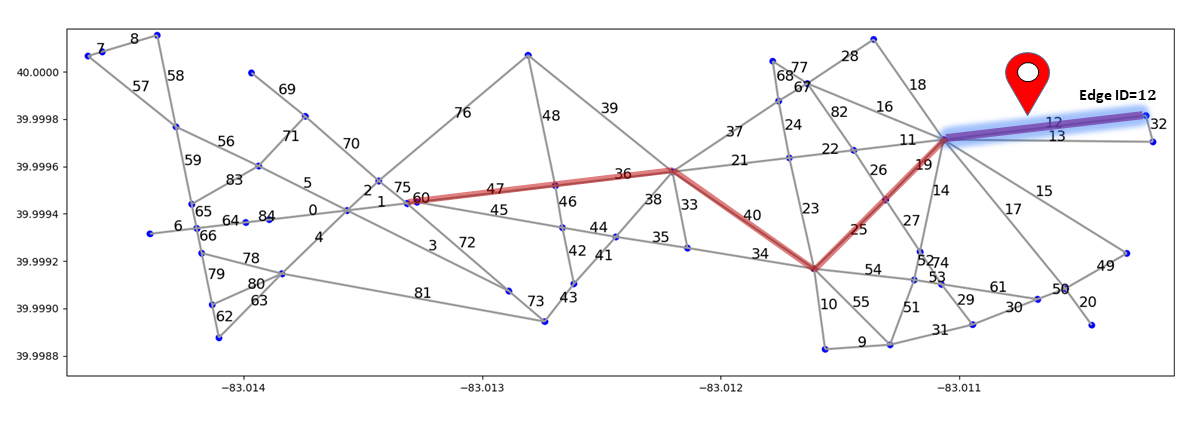
Given a topological representation of a map \(G\) with a finite set of nodes \(V\) and edges \(E\), each edge can be assigned a unique id. When a trajectory is produced by another sensor — inertial or visual — the sequence of significant turning angles along it can be computed and quantized into discrete values. The output is the id of the edge on which the last significant turning angle occurred.
Localization therefore becomes a variable-length time series classification problem, which can be solved with sequence models.
Related publications
- Map-Based Temporally Consistent Geolocalization through Learning Motion Trajectories, ICPR 2020
- Trajectory Mining for Localization using Recurrent Neural Network, CSCI 2019